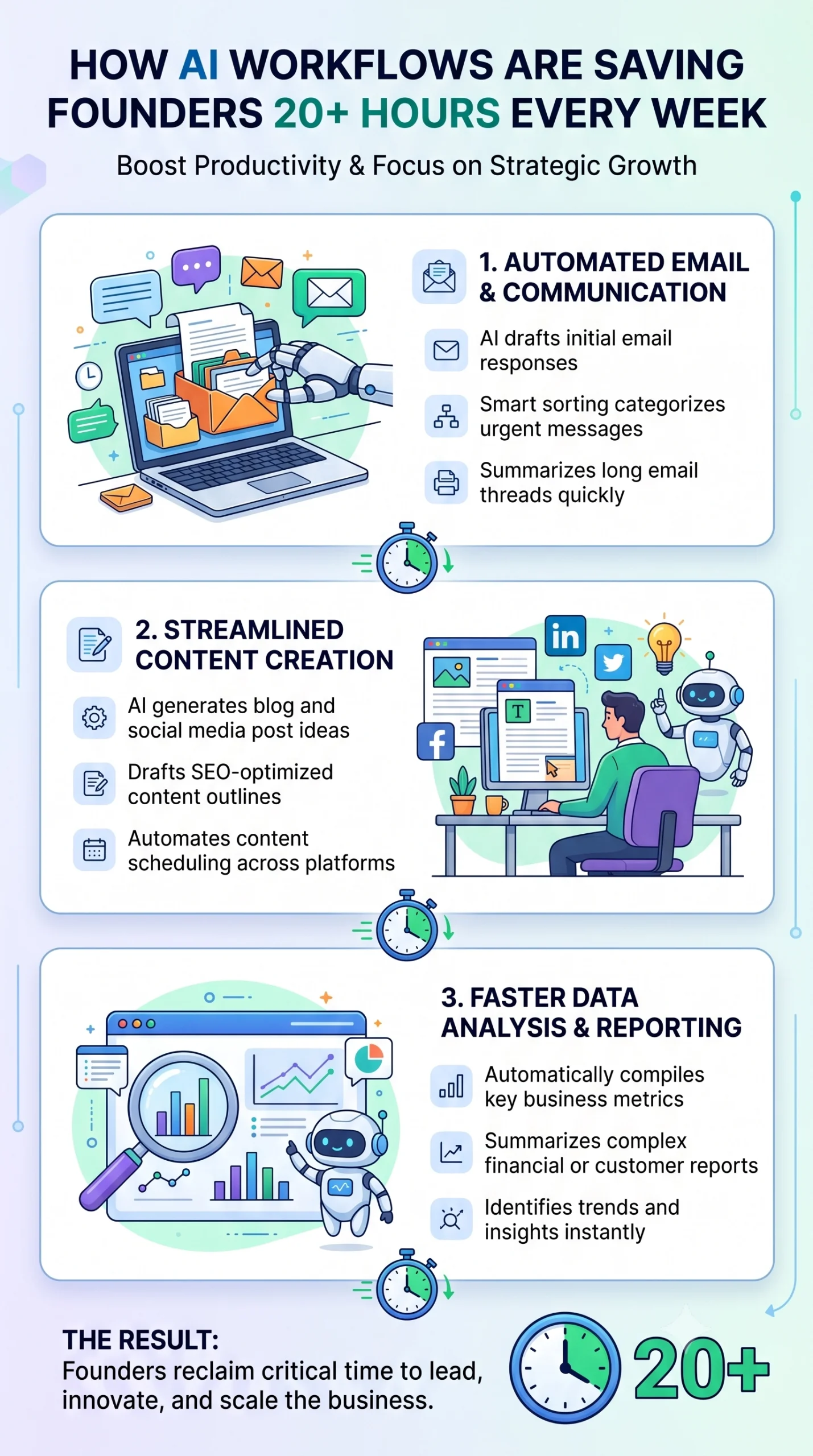
How AI Workflows Are Saving Founders 20+ Hours Every Week
Every startup founder and entrepreneur knows the feeling. You start your day with an ambitious plan to focus on high-level strategy and client acquisition, only to end it clicking through invoices, answering repetitive emails, and manually copying data between spreadsheets.
This phenomenon has a name: administrative drag—the bureaucratic brake that effectively stalls your business growth.
However, top managers and founders of fast-growing companies have found a way to „buy back” their time. The key to success lies in automated workflows powered by AI (AI Workflows). Thanks to these systems, leaders are reclaiming over 20 hours every single week. How do they do it? Here is the exact blueprint.
What Are "AI Workflows" and Why Are They a Game Changer?
Traditional automation (like simple rules in Zapier) operated on the basic principle of "if X happens, do Y". While useful, this approach is highly limited because it cannot handle nuance.
Implementing AI introduces an element of "thinking" to this equation. Artificial intelligence can analyze context, draw conclusions, and make decisions based on unstructured data (such as the tone and intent of an incoming email from a client). An AI workflow connects multiple tools into a single, self-sustaining ecosystem that runs 24/7 without your direct intervention.
3 Areas Where AI Completely Eliminates Administrative Drag
Scaling companies don't just automate everything mindlessly. They focus on three key areas that generate the most friction and waste the most executive time:
1. Intelligent Inbox Triage and Management
Instead of spending the first two hours of the day sorting through emails, founders delegate this to AI. The system can:
Analyze the content of incoming messages.
Classify them into specific categories (e.g., "complaint," "partnership offer," "invoice").
Extract key data and automatically prepare a draft response, leaving it waiting for a single click of approval from the founder.
2. Automated Market Research and Monitoring
Gathering competitor data or analyzing market trends can swallow up entire evenings. Properly configured AI agents can scour the web daily, aggregate the most critical information, and deliver a concise, single-screen summary with actionable insights directly to the founder at the end of the week.
3. Onboarding and Document Management
Bringing a new client or employee into your system, generating contracts based on templates, and sending follow-up reminders are repetitive processes where humans often just act as a "bridge" between different applications. AI glues these systems together, reducing operational time by up to 90%.
How to Start Buying Back Your Time: Your First Step
You don't need to build complex programmatic systems or hire an expensive agency right away. To see the first results of AI workflow automation for business, apply this simple three-step rule:
Track your activities for a week: Note any task on your computer that takes longer than 15 minutes and feels repetitive.
Pick one low-hanging fruit: Choose the simplest repetitive task, such as moving data from a website contact form into your CRM.
Use no-code tools: Combine platforms like Make.com or Zapier with APIs from OpenAI or Anthropic to create your very first automated workflow.
Conclusion
Time is the most valuable currency for any founder. Spending it on putting out administrative fires is a poor investment. AI workflows won't replace your strategic vision or your human relationships—but they will lift the digital weight off your shoulders, finally allowing you to focus on what truly drives your business forward.